Menu
The following was contributed by Kim Wolf, niece of Gorm Lottfield
The Castle on Sweetwater
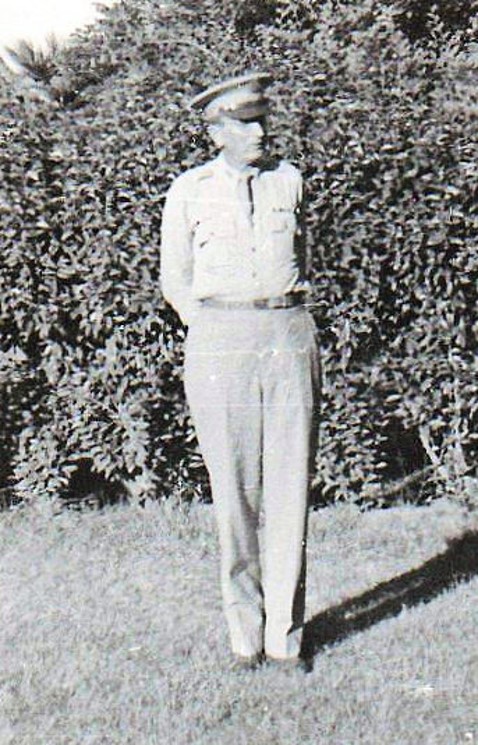
People traveling on Silverbell Road in northwest Tucson who turn onto Sweetwater Drive may glimpse a crenelated rock tower above the trees—an unexpected appearance in the Arizona desert. For obvious reasons, it is referred to as the “Castle.” Gorm Loftfield, the builder of that iconic structure and the small house beside it, was an early settler in Tucson, and one of the homesteaders who came together in 1934 and established the Tucson Mountains Association. For much of his life he was prominent in Tucson’s past. He was not an idealistic visionary—he was a studious man, somewhat stern, who settled in Tucson in 1920 and spent the rest of his life contributing to the betterment of his community.
Education and Career
Gorm received his degree in Civil Engineering from the University of Minnesota, after which he served in the Engineering Corps in France during WWI. Returning from service in 1919, he and his brothers decided to settle in Tucson. In 1920, he bought a house right next to the University of Arizona, and continued his education. He received his MS in Chemistry in 1921 and PhD in Plant Physiology in 1924 at the University. He accepted a job as professor of Botany at Texas A & M for a year, but was back in Tucson in 1926 working as County Engineer and Superintendent of Roads in Pima County. By 1928 he had become Valuation Engineer for the Pima County Assessor’s Office and was instrumental in setting up the county’s assessed valuation tables. Except for the time he returned to active duty during WWII, he held that position until his retirement in 1960.
Homesteading in the Tucson Mountains
In the early 1930’s, Gorm applied for a tract of land in the Tucson mountains under the Homestead Act of 1862. That 160 acres would be granted to him if a structure he built on the plot was occupied for five continuous years. By 1932 he had constructed and moved into a small house there. It was unique because it was built of treated railroad ties with a mortar fill between them, rather than the adobe structures so common in that area. He occupied it for the required years and in March 1939 he was granted homestead rights to the property, with a deed signed by President Franklin D. Roosevelt. A well was dug which supplied an ample amount of water.
Founding the Tucson Mountains Association
On June 14, 1934, a few residents living in the area, headed by Gorm, Joseph Canfield, and Joseph Coniff, met and formed the Tucson Mountains Association. What started as a small group continued to grow while promoting the well-being of the area and its environment. They worked to prevent soil erosion, improve roads, and in 1936 were involved in efforts to bring power lines into the district, according to an article in the Arizona Daily Star, Dec. 23, 1936. Gorm continued to be an active member, holding various offices, throughout his life.
Family Man
As the oldest of nine brothers and sisters, Gorm took on many family responsibilities. When his father died in his home state of Minnesota in 1929, he brought his mother and younger siblings to live in his Tucson city house. His widowed sister, Sigrid, took residence there to care for their mother and to keep house and cook for the numerous relatives who came and went. He was always an important part of his large family, and his nieces and nephews remember him as being a talented storyteller with a prodigious memory who lulled them to sleep with long stories. They never stayed awake long enough to hear the endings. Gorm maintained and improved the city house, as well as continuing to manage his homestead property, until WWII interrupted his plans and he was recalled to duty.
A Rock House in the Desert
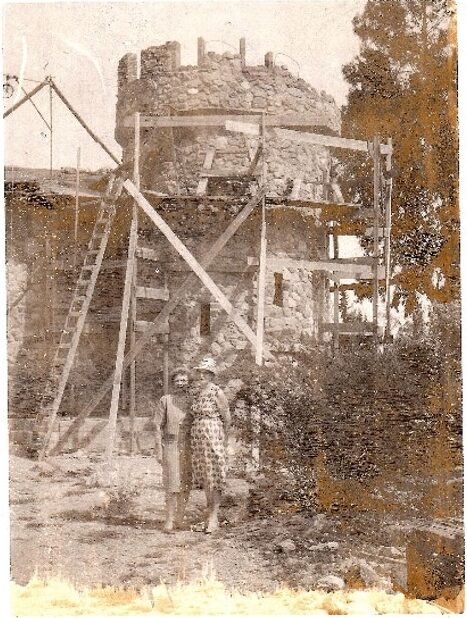
When he returned to Tucson, he embarked on several projects. A rock wall was built around a large yard area of the homestead, and the house was modernized with plaster and paint applied over the railroad ties, and the addition of a front porch. On the land to the west of the homestead he began a second dwelling, this one built entirely of rock. It had two stories, with the living quarters on the second level, and storage rooms below. At the back of the living area was a door which was always kept locked, because it opened to a drop-off. Gorm planned that door to open onto a tower stairwell which would be constructed later. Perhaps his extensive knowledge and love of Norwegian mythology which he delighted in sharing with family members led him to think in terms of the fairy tale structure he wanted to add to his desert house.
By the time the rock house was ready to be lived in, in 1947, the University of Arizona embarked on a large building plan which absorbed the property of his city house. His sister moved into the rock house until she relocated to California in 1952, while Gorm resided in the homestead cabin. With acreage to spare, he sold plots of land, many to brothers and sisters who also migrated to Tucson. He had abundant water, and many of his neighbors were not so lucky with their wells. He built a reservoir on his property, and in early August, 1950, he was granted an application “for the purpose of installing, maintaining and operating a water plant and water distribution system” for a period of 25 years, according to the permit. His stepdaughter believed that the seemingly endless supply may have had something to do with the naming of Sweetwater Drive.
Marriage and Retired Life
A new phase of his life began in 1955 when he married Florence Alloway, the widow of a local doctor. The authoritarian older brother who had so many family responsibilities began to relax and enjoy his married life. Although the couple lived for several years in her house on Ironwood Drive, he continued to run his water company and make plans for the completion of the rock house. By 1959, the couple had taken up residence there and the long-envisioned tower with the circular staircase was underway.
While the work progressed, both Gorm and Florence continued to be active in all the activities of the Tucson Mountains Association. Gorm retired from the County Assessor’s office in July, 1960, and In November, according to the Tucson Citizen Newspaper, he was elected president of the TMA, with Florence serving as secretary.
The retirement years were peaceful. The tower was finished and a pool was added to complete the idyllic life they enjoyed until Gorm passed away in 1978. The “castle” and homestead are sturdy buildings which will remain for years to commemorate an important man in the history of Tucson, and the many contributions he made, both to the town and to the Tucson Mountains Association.
Florence continued to live in the rock house for the rest of her life. Her daughter, Laurel Rottura, moved into the homestead where she was close to her mother. Both Florence and Laurel continued to be active members of the TMA. Florence made several additions to the rock house; she expanded the front, eliminating the balcony, and had a large screened porch overlooking the pool area built upstairs. She oversaw the construction of a memorial to Gorm on the wall in back of the Homestead to house his ashes, as well as the ashes of other family members. Florence lived to be 99 years old. Laurel inherited the property after Florence’s death and continued to live in the Homestead until her own death in 2014, after which the property left the family. Both buildings and the water reservoir remain to mark an important part of Tucson history.